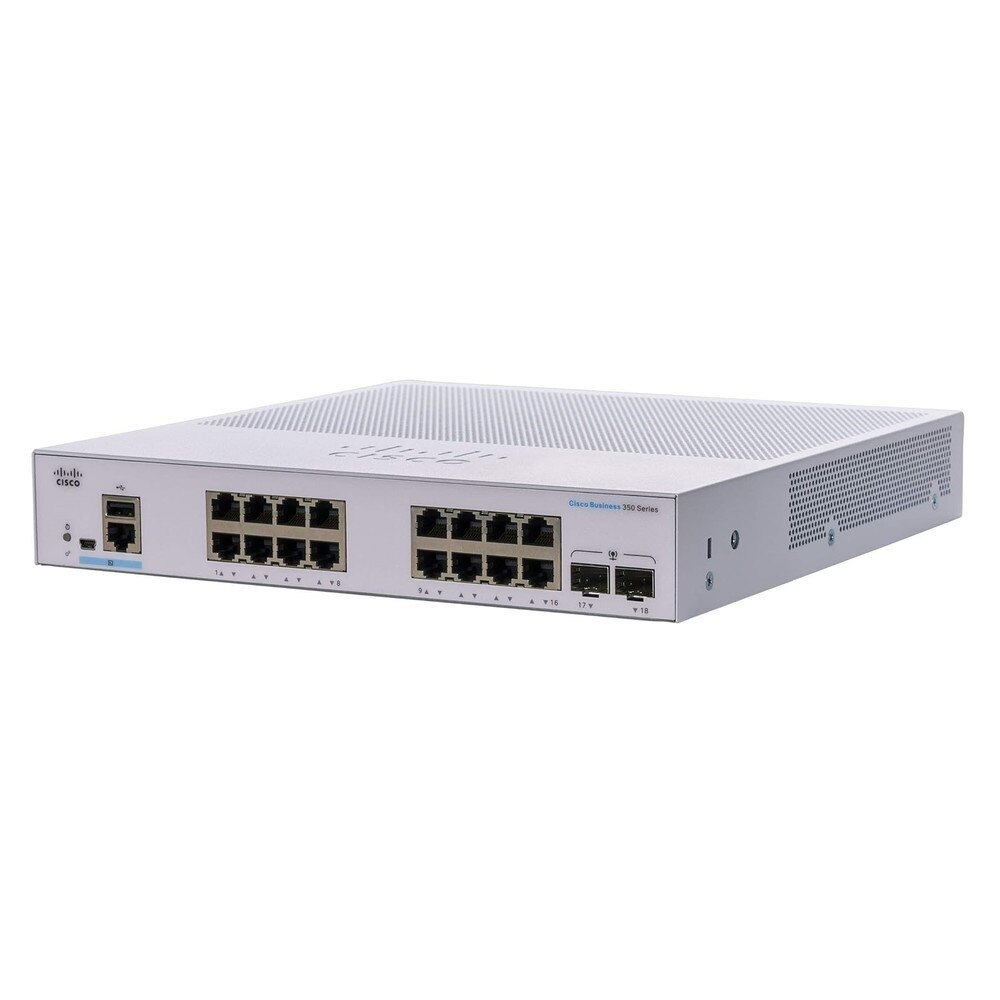
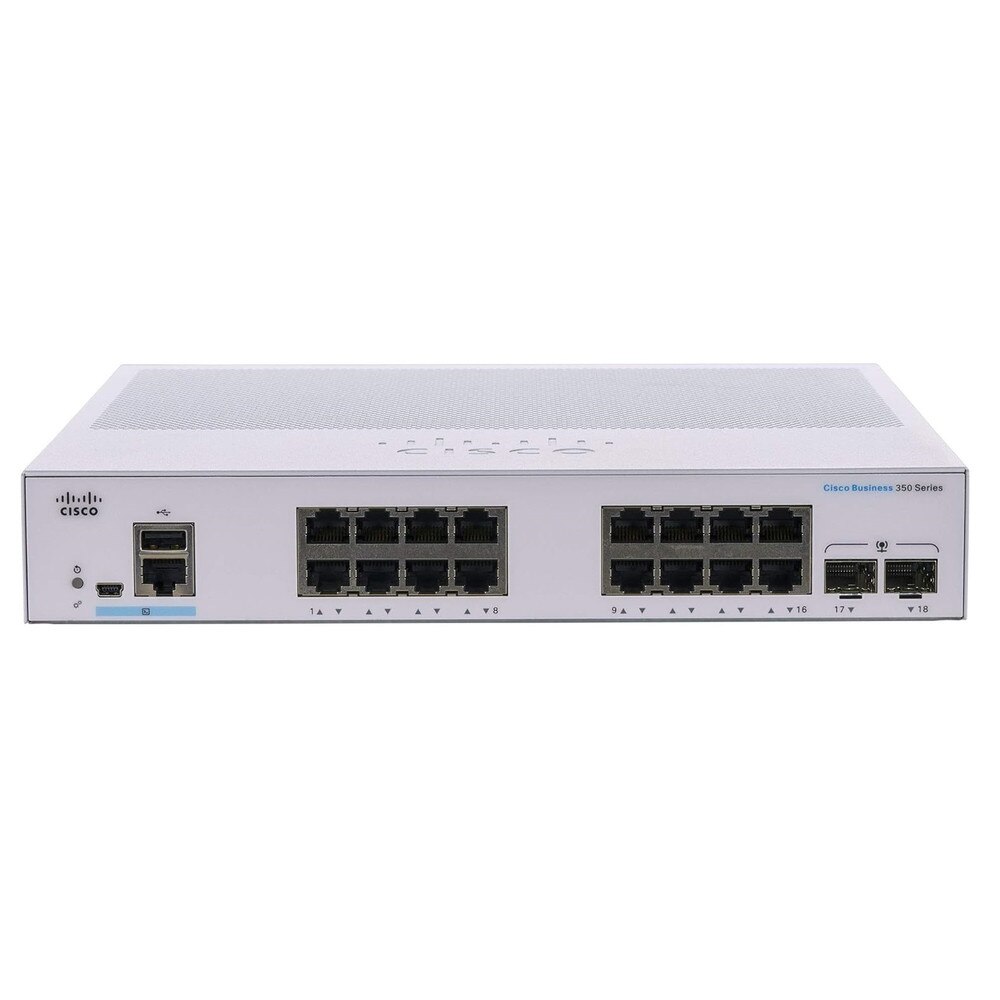
Cisco CBS350-16T-2G 16-Port Gigabit Managed Network Switch with SFP (NA) | Refresh
SKU: CBS350-16T-2G-NA-RF
 Same Day Shipping - Arrives in 3-5 Business Days
 /returns-icon.jpg) 30-day Returns
30-day Returns 
Have one to sell? Click here to sell to us
Same Day Shipping - Arrives in 3-5 Business Days 30-day Returns Have one to sell? Click here to sell to us
The Cisco CBS350-16T-2G 16-Port Gigabit Managed Network Switch with SFP (NA) is built for small and medium-sized enterprises that want dependable, secure wired connectivity without PoE. It gives businesses a useful way to connect users, printers, servers and other data-only endpoints while extending the network over fiber to a core switch, server room, or remote building by combining 16 Gigabit RJ45 ports with two Gigabit SFP uplink slots. The CBS350-16T-2G, a small 1RU rack-mountable platform in the Cisco Business 350 Series, offers enterprise-style QoS, strong security, powerful Layer 3 capabilities and centralized management choices. It is an efficient managed gigabit switch for quiet offices, branch locations, classrooms, retail sites and professional network closets due to its 36 Gbps switching capability, wire-speed forwarding and fanless architecture.
• 16 × 10/100/1000 Mbps Gigabit Ethernet RJ45 ports provide high-speed wired connectivity for workstations, printers, servers and network appliances.
• 2 × 1GbE SFP uplink ports support fiber connectivity to core switches, aggregation devices, storage and longer-distance network links.
• Non-PoE design is ideal for data-only devices and environments where endpoints use local power or separate PoE switching.
• 36 Gbps switching capacity and 26.78 Mpps forwarding performance deliver wire-speed, nonblocking traffic handling.
• Full Layer 3 management supports static routing, RIP, OSPF, policy-based routing, DHCP relay, IPv4/IPv6 routing and inter-VLAN routing for scalable network segmentation.
• Up to 4,094 VLAN IDs and 255 active VLANs support separation of users, guest systems, voice services, surveillance, wireless and IoT infrastructure.
• IEEE 802.3ad LACP link aggregation provides higher bandwidth and resilient connections between switches, servers and NAS appliances.
• STP, RSTP, MSTP, PVST+, Rapid PVST+, root guard, loop guard and BPDU protection help prevent Layer 2 loops and support network availability.
• Advanced QoS uses eight hardware queues per port, traffic classification, policing, shaping and remarking to prioritize voice, video, cloud and collaboration traffic.
• IEEE 802.1X, RADIUS, TACACS+, ACLs, DHCP snooping, Dynamic ARP Inspection, IP Source Guard, IPv6 protections and DoS prevention help secure the wired network.
• Cisco Business Dashboard, embedded web GUI, CLI, SNMP, Cisco Business mobile app and Cisco Network Plug and Play provide flexible configuration and monitoring options.
• Dual firmware images support safer software maintenance by keeping a backup image for rollback and recovery.
• Fanless architecture helps support quiet operation in office and desk-adjacent installations.
• 1RU rack-mountable chassis with internal power supply supports professional deployment.
🗹 Connects up to 16 wired devices from a single managed Gigabit switch, making it ideal for small offices, satellite locations, meeting spaces and edge-network deployments.
🗹 Extends the LAN over fiber with two Gigabit SFP slots, which can help bridge longer distances and reduce susceptibility to electrical interference.
🗹 Supports quiet deployment in offices and classrooms with fanless operation, avoiding the noise associated with active cooling.
🗹 Enables IT teams to separate users, business systems, guest access, voice devices, surveillance and IoT assets through VLANs and Layer 3 routing policies.
🗹 Improves voice calls, video conferencing, cloud applications and data transfers by assigning priority to critical traffic through granular QoS controls.
🗹 Strengthens access-layer protection with authenticated port access, ACL-based policies, DHCP and ARP protections and denial-of-service safeguards.
🗹 Simplifies daily administration with Cisco Business Dashboard, browser-based tools, standard SNMP monitoring and flexible local or remote management.
🗹 Provides a scalable foundation for business networks that need enterprise-class control and security without adding PoE hardware or excess power consumption.
| Manufacturer | Cisco |
| Manufacturer Part Number | CBS350-16T-2G-NA-RF |
| Product Name | Cisco CBS350-16T-2G 16-Port Gigabit Managed Network Switch with SFP |
| Product Type | Networking Switch |
| Form factor | Fixed configuration, 1RU rack-mountable |
| Total system ports | 18 |
| RJ45 network ports | 16 × 10/100/1000BASE-T Gigabit Ethernet |
| Uplink ports | 2 × 1GbE SFP / 1000BASE-X slots |
| PoE support | No; data-only, non-PoE model |
| Management ports | 1 × RJ45 console, 1 × USB Type-B console, and 1 × USB Type-A |
| Switching capacity | 36 Gbps |
| Forwarding rate | 26.78 Mpps for 64-byte packets |
| Switching architecture | Wire-speed, nonblocking |
| CPU | ARM processor at 800 MHz |
| DRAM | 512 MB |
| Flash memory | 256 MB |
| Packet buffer | 1.5 MB |
| MAC address table | Up to 16,000 entries |
| Jumbo frame support | Up to 2,000 bytes |
| Link aggregation | IEEE 802.3ad LACP; static and dynamic aggregation supported |
| Link aggregation groups | Up to 8 LAGs |
| Active ports per LAG | Up to 8 |
| Spanning Tree Protocol | IEEE 802.1D STP, IEEE 802.1w RSTP, IEEE 802.1s MSTP, PVST+, and Rapid PVST+ |
| MSTP instances | Up to 8 |
| PVST+ / Rapid PVST+ instances | Up to 126 |
| Loop protection | Loopback detection independent of STP |
| Flow control | IEEE 802.3x |
| Energy Efficient Ethernet | IEEE 802.3az |
| VLAN identifiers | Up to 4,094 VLAN IDs |
| Active VLANs | Up to 255 |
| VLAN support | IEEE 802.1Q tag-based VLANs and port-based VLANs |
| VLAN functions | Management VLAN, Guest VLAN, Voice VLAN, Private VLAN Edge, GVRP, and GARP |
| Voice VLAN | Supported with automatic voice traffic classification and QoS prioritization |
| Endpoint discovery | Cisco Discovery Protocol, LLDP, LLDP-MED, and Voice Services Discovery Protocol |
| Multicast support | IGMP snooping v1/v2/v3, IGMP querier, IGMP fast leave, source-specific multicast, MLD snooping v1/v2, and MLD querier |
| Multicast group capacity | Up to 1,024 groups |
| IPv4 routing | Static routing, RIP v2, OSPFv2, policy-based routing, DHCP relay, UDP relay, and CIDR |
| IPv6 routing | Static routing, RIPng, OSPFv3, policy-based routing, DHCP relay, UDP relay, and CIDR |
| IPv4 static routes | Up to 990 |
| IPv6 static routes | Up to 256 |
| IP interfaces | Up to 128 |
| Layer 3 interfaces | Physical port, LAG, VLAN interface, and loopback interface |
| DHCP services | DHCP relay, UDP relay, and DHCP server capability |
| First-hop redundancy | VRRP supported |
| Access control lists | Layer 2 through Layer 4 ACLs |
| ACL capacity | Up to 1,024 ACL rules |
| Port authentication | IEEE 802.1X |
| Authentication services | RADIUS authentication and accounting, TACACS+, MAC-based authentication, web-based authentication, and Guest VLAN |
| Security controls | Port security, DHCP snooping, IP Source Guard, Dynamic ARP Inspection, IPv6 Source Guard, IPv6 DHCP Guard, IPv6 Router Advertisement Guard, DoS protection, and storm control |
| QoS queues | 8 hardware priority queues per port |
| QoS scheduling | Strict Priority and Weighted Round Robin |
| QoS classification | Port, 802.1p CoS, DSCP, IP precedence, TCP/UDP port, VLAN, ACL, and MAC address |
| QoS functions | Rate limiting, policing, shaping, queue assignment, and packet remarking |
| Stacking | Not supported on this model |
| Firmware resiliency | Dual firmware images support upgrade rollback and operational continuity |
| Operating system | Customized Linux OS |
| Embedded management | Web-based GUI and configuration wizards |
| CLI access | RJ45 console, USB Type-B console, Telnet, and SSH |
| Centralized management | Cisco Business Dashboard |
| Mobile management | Cisco Business mobile app |
| Zero-touch provisioning | Cisco Network Plug and Play |
| SNMP | SNMPv1, SNMPv2c, and SNMPv3 |
| Monitoring | RMON, port mirroring, sFlow, cable diagnostics, event logging, and system logging |
| Secure management | HTTPS, SSH, SSL/TLS, SCP, RADIUS, TACACS+, and SNMPv3 |
| File transfer and configuration | TFTP, HTTP, HTTPS, SCP, configuration backup, and restore |
| Time synchronization | NTP and SNTP |
| IPv6 management | Supported |
| Bluetooth | Optional external Bluetooth dongle supported through USB Type-A port |
| LEDs | System, Link/Activity, and Speed |
| Ethernet standards | IEEE 802.3, 802.3u, 802.3ab, 802.3z, 802.3x, 802.3ad, 802.3az, 802.1D, 802.1Q, 802.1p, 802.1w, 802.1s, 802.1X, and 802.1ab |
| Copper cabling | Category 5e or higher for 1000BASE-T |
| Supported uplink media | Compatible 1GbE SFP optical transceivers and supported direct-attach copper cables |
| Power supply | Internal universal AC power supply |
| AC input voltage | 100–240 VAC |
| Input frequency | 50–60 Hz |
| Maximum system power consumption | 18.63W with 110 VAC |
| Maximum system power consumption | 18.37W with 220 VAC |
| Maximum heat dissipation | 64.46 BTU/hr |
| Cooling | Passive cooling; fanless design |
| Acoustic noise | 0 dB; fanless operation |
| Dimensions, W × D × H | 268 × 272 × 44 mm (10.56 × 10.69 × 1.73 in.) |
| Weight | 1.78 kg (3.92 lb.) |
| Operating temperature | -5°C to 50°C (23°F to 122°F) |
| Operating humidity | 10% to 90%, noncondensing |
| Storage temperature | -25°C to 70°C (-13°F to 158°F) |
| Storage humidity | 10% to 90%, noncondensing |
| MTBF at 25°C | 2,165,105 hours |
| Mounting | Rack-mount kit included; desktop placement supported with included rubber feet |
| Software licensing | Perpetual license; no subscription required for core switch operation |
The switch provides 16 10/100/1000 Mbps Gigabit Ethernet RJ-45 ports for wired network endpoints.
It includes two dedicated Gigabit SFP ports, giving administrators additional connectivity for compatible fiber or copper transceivers.
The CBS350-16T-2G provides 18 total Gigabit Ethernet ports: 16 RJ-45 interfaces and two SFP ports.
No. This particular model is non-PoE. Cisco lists separate CBS350-16P-2G and CBS350-16FP-2G models when PoE+ connectivity is required.
No. Cisco identifies the CBS350-16T-2G as having 16 Gigabit Ethernet RJ-45 ports plus two SFP ports, rather than copper/SFP combo interfaces.
The two interfaces are Gigabit SFP ports, supporting compatible 1GbE transceivers. They are not 10G SFP+ interfaces.
Cisco specifies a 36 Gbps switching capacity with wire-speed, nonblocking switching.
The switch provides a forwarding performance of approximately 26.78 million packets per second using 64-byte packets.
The CBS350-16T-2G includes a 1.5 MB dynamically shared packet buffer.
Yes. Compatible optical SFP modules can be installed in the two SFP ports. Cisco lists options for multimode and single-mode fiber with supported distances ranging from hundreds of meters to tens of kilometers, depending on the transceiver.
Yes. Cisco lists compatible Gigabit copper options such as MGBT1 and GLC-TE, which support 1000 Mbps over suitable Category 5e cabling up to 100 meters.
Yes. VLAN capabilities allow administrators to logically separate departments, servers, guest users, management systems and other traffic groups.
Yes. The CBS350 family provides Layer 3 capabilities, allowing organizations to implement routing functionality in addition to traditional Layer 2 switching.
Yes. QoS capabilities help administrators classify and prioritize important traffic such as voice, video conferencing, and other delay-sensitive applications.
Yes. Link aggregation allows compatible interfaces to be grouped to provide additional aggregate bandwidth and greater network-design flexibility.
Yes. The CBS350 Series provides multiple network-management options, enabling administrators to configure, monitor and troubleshoot the switch without relying solely on physical console access.
Yes. Cisco specifies a standard RJ-45 console port for direct local administration.
Yes. A USB Type-A slot on the front panel supports convenient file and software-image management.
The CBS350-16T-2G measures approximately 268 x 272 x 44 mm (10.56 x 10.69 x 1.73 inches), providing a compact rack-mountable footprint.
It is a strong fit for small and medium-sized businesses, branch offices, professional workgroups, retail environments, server rooms and other managed non-PoE networks that need 16 Gigabit copper ports, fiber uplinks, VLAN segmentation, routing capabilities, and centralized network administration.